Auditions
Singing With a Live Accompanist vs. a Backing Track
By Juliana Polansky · November 3, 2026 · 7 min read
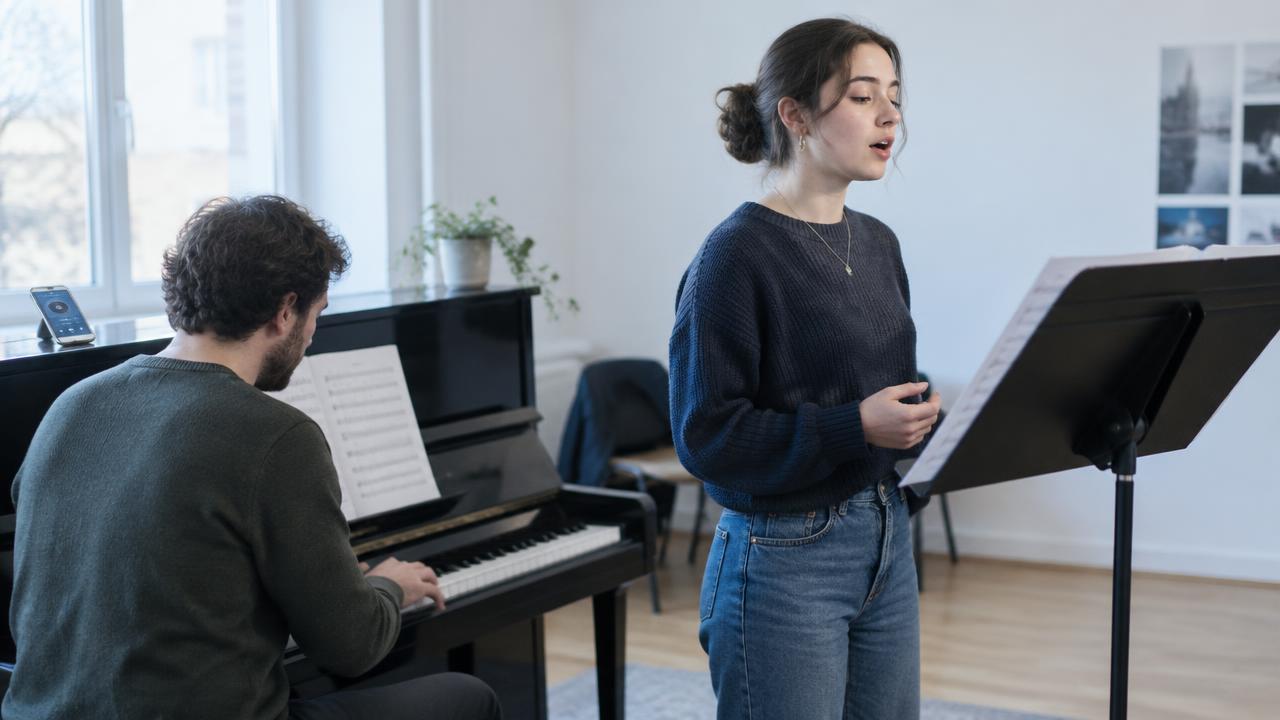
When a student asks whether to sing with a pianist or a backing track, I start with a different question: what does this particular rehearsal or audition require you to do? A live accompanist can respond to a breath, shape a transition, and help restore the musical thread after a slip. A track offers repeatability and independence, but it will not wait while you find your next word. Singing without accompaniment exposes another set of habits entirely. I use all three approaches in lessons, but not interchangeably. The useful choice depends on the submission rules, the musical style, and whether we are developing interpretation, testing rhythmic independence, or preparing a performance that must work reliably on recording.
Should I use a live pianist or a backing track?
I first ask the student to read the audition instructions before making an artistic decision. If a pianist is provided, prepare readable sheet music and clear musical intentions rather than assuming you can substitute a recording. If a recorded submission requires a backing track, practice within that condition early. Bringing your own pianist may require explicit permission. Where the format allows a choice, I consider how much timing flexibility the piece needs, how confidently the singer maintains the pulse, and what rehearsal access is realistically available.
In a lesson, I choose accompaniment according to the problem we are solving. If a student is leaning on the piano melody to find every entrance, I may ask for a short passage without accompaniment. If the difficulty is coordinating a breath with a harmonic change, accompaniment becomes useful immediately. If we are preparing a recorded audition, the actual submission track should enter the process before the final recording session. I do not treat singing alone as a lesser option, but neither do I assume that success alone proves readiness to sing with someone else.
What can a live accompanist do that a track cannot?
A responsive pianist can hear the preparation for a phrase and coordinate an entrance with the singer's breath. That does not mean waiting indefinitely or following every hesitation. It means negotiating musical time together. Rubato—the intentional stretching and returning of time—works best when both musicians understand the phrase's destination. I ask students to identify where they want space and where the pulse should become clear again. A pianist can then shape the harmony around that intention instead of merely chasing a singer who has slowed down unexpectedly.
A live accompanist may also help recover from a missed entrance or skipped word by recognizing where the singer has landed and reconnecting the accompaniment. That flexibility is valuable, but it is not guaranteed: sight-reading conditions, the score, and rehearsal time all matter. I teach students to keep listening and locate the next dependable musical landmark rather than stop and apologize. Before singing, communicate the tempo, any agreed cuts, and an unusual entrance or ending. A brief, clear conversation is more useful than trying to explain every expressive choice at the piano.
- Give a clear starting tempo.
- Mark cuts and transitions legibly.
- Agree where flexible time returns to pulse.
When is a backing track the better choice?
A good backing track gives a student a stable rehearsal partner. The introduction, tempo, and harmonic support remain consistent, so changes between takes are easier to hear. It also removes the need to coordinate pianist availability for every practice session. For online audition submissions, tracks are often part of the requested setup, though the specific instructions always take priority. I want students comfortable with that reality. The goal is not to imitate a live collaboration perfectly; it is to make a convincing musical performance within an accompaniment that has already been fixed.
I listen for whether the arrangement supports the actual song and the student's choices. A track in the right key can still have an unsuitable tempo, an awkward ending, or instrumental lines that obscure the vocal entrance. Some tracks contain built-in tempo changes, so knowing the opening pulse is not enough. I ask students to map the whole recording and notice where it offers space. If a phrase requires more time than the track allows, we reconsider the track or the phrasing rather than force a rushed breath or an oversized final note.
- Choose support, not a competing lead vocal.
- Check transitions as well as the opening.
- Rehearse with the exact submission version.
How do I practice when no pianist is available?
Without a pianist, I separate learning the notes from learning to stay oriented. First, establish the starting pitch with a keyboard or pitch reference, then sing a short passage without accompaniment. Speak its rhythm against a metronome and identify rests, pickups, and places where a long note can hide a lost beat. Next, sing it again and check the arrival pitch against the keyboard. This is not a demand for perfect pitch. It is a way to notice whether the phrase drifts before a full accompaniment makes the problem less obvious.
I then alternate three versions: the passage alone, with a steady pulse, and with the backing track. Each exposes something different. Unaccompanied singing reveals whether I am hearing the line internally; the pulse checks duration; the track tests coordination with harmony and entrances. To prepare for a pianist, I also practice giving a clear preparation and continuing after a small mistake without restarting. When a pianist becomes available, even a focused rehearsal of the opening, one flexible passage, and the ending can reveal coordination issues that solo practice cannot.
What should I check before sending an audition backing track?
Before a student sends a track to an accompanist, recording partner, or audition team, I have them play the exported file from beginning to end. Confirm the key by singing the opening and checking the range, not by trusting the filename alone. Verify the tempo through every transition. The count-in or introduction must make the entrance unmistakable without adding unnecessary waiting. Check for an abrupt ending, accidental silence, or a guide vocal left in the mix. Follow the recipient's file-format requirements; if none are stated, ask rather than assume every device will handle the same file.
Levels need two checks: the track itself and its balance with the singer in the finished recording. Listen for distortion, then record a short trial to confirm that the accompaniment supports rather than covers the words. Play that trial on a phone speaker as well as headphones; an entrance audible in headphones may disappear on a small speaker. I also check that the final file opens outside the editing app and that its name clearly identifies the song, key, and version. For submissions, review the audition instructions once more before sending the actual performance.
- Confirm key, tempo, and a clear count-in.
- Check levels, vocal balance, and required file format.
- Test the exported file and phone-speaker playback.
Juliana Polansky recommends: Choose eight measures with an entrance after a rest. Speak the rhythm, sing them without accompaniment, then record them with your track. Compare the entrance and final release before changing anything else.

About the author
Juliana Polansky
Vocal coach specialising in classical technique and musical theatre, teaching private lessons online and in person by request in Southern California.
If you are working through similar vocal concerns, preparing for an audition, or have specific goals for your voice, you are warmly welcome to reach out — we can start with a private diagnostic consultation.