Online Coaching
Inside the Screen: How I See and Fix Vocal Tension in Online Voice Lessons
By Juliana Polansky · November 1, 2026 · 7 min read
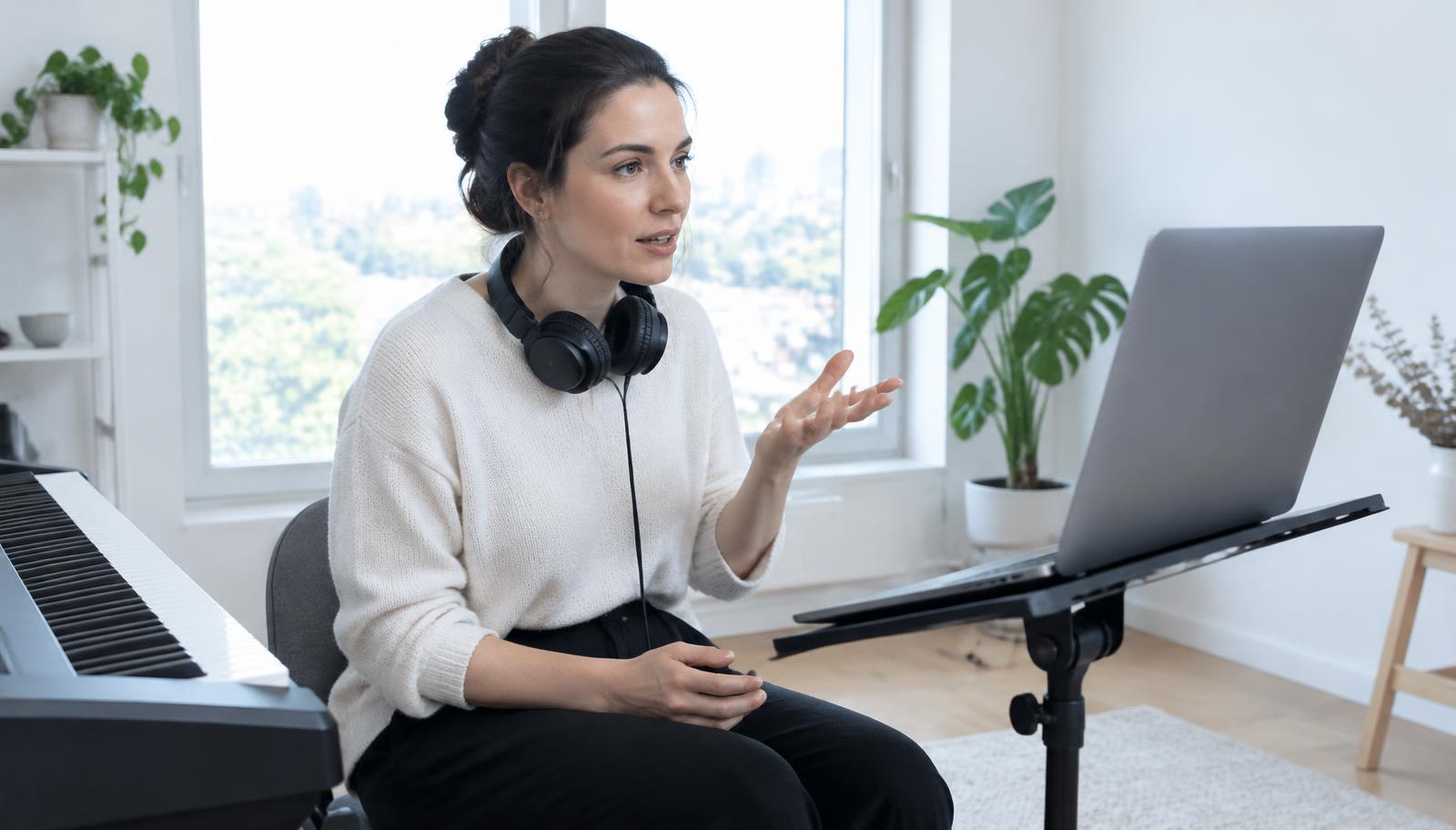
When singers hear 'online lessons', many imagine a compromised version of the real thing: the coach squinting at a small image, guessing at what the sound is doing, correcting only what a camera can show. After years of teaching this way, my answer is the opposite. A well-run online lesson is not a diluted in-person lesson — it is a different instrument of observation, with its own advantages. The camera sees the jaw, the shoulders, the breath cycle and the tongue with a closeness a singer almost never gets in a studio mirror. And the fixes happen in the room where you actually practise, which is precisely where habits are made.
The camera sees more than you think
Vocal tension announces itself visually long before it becomes pain. In an online lesson I watch a handful of reliable signals: the jaw that jumps forward on high notes; the tongue that pulls back and bunches on certain vowels; the shoulders that lift with every intake of breath; the neck muscles that stand out as a phrase climbs; the ribs that never seem to move while the chest rises. None of these require studio acoustics to observe — a well-placed camera at chest height, with light on the face and shoulders, shows all of them clearly.
I ask students to frame themselves from the top of the head to the hips. That single instruction matters more than any equipment choice, because the breath cycle is only visible if the ribs and abdomen are in the picture. A singer who sees their own posture in the corner of the screen while we work begins, within weeks, to self-correct in real time — which is the entire point of coaching.
What the sound tells me through a laptop
It is true that video call audio is compressed, latency is real, and I cannot accompany a student live in sync. So an honest online lesson is organised around what survives the compression. Pitch, vowel quality, onsets, breathiness, register flips, phrasing and tension habits are all audible through a call with reasonable clarity. What is not reliable is exact dynamic shading and precise milliseconds of coordination — and there are workarounds for both.
The main workaround is recording. I frequently ask a student to record a phrase on their phone, in the room, and play the file back during the lesson — the phone recording is far more accurate than the live call audio, and it lets us hear the true sound rather than the compressed version. This has a second benefit that surprises many singers: playback removes the internal distortion of hearing your own voice from inside, so students often recognise problems in a recording that they argued about in the moment.
- Wired or good-quality headphones, and the device at chest height on a stand or stack of books.
- A quiet room with soft furnishings beats an expensive microphone every time.
- Phone recordings of phrases, played back in the lesson, give the truest picture of the voice.
Why fixes learned in your own room stick
In an in-person lesson, a singer performs the correction inside the teacher's studio and then goes home to a different room, a different piano or backing track, and a different acoustic picture. In an online lesson, the correction is rehearsed from the first minute in the exact spot where tomorrow's practice will happen. The chair, the light, the device position, even the water glass on the same shelf — the new coordination is being filed in the same place the old habit lived. In my experience this shortens the path from 'I can do it with the coach' to 'I can do it on Wednesday afternoon' considerably.
A tension audit you can do at home
Between lessons, singers can run a simple self-check in front of the camera. Record one minute of your current piece, then watch the playback with the sound off, looking only at the body: jaw, tongue visible at the teeth, shoulders, neck, ribs. Then listen with the picture off, looking only for breath — where it starts, whether it is noisy, whether it runs out. Ten minutes of this, once a week, catches most tension habits while they are still small.
- Video with sound off: watch jaw, shoulders and breath cycle.
- Audio with picture off: listen for noisy intake and end-of-phrase squeeze.
- One change at a time — a single correction, practised for a week, beats five at once.
When online is not enough
Some things still belong in person: a persistent medical concern, a voice in recovery, or the fine adjustments of a professional singer preparing a role are better served by hands-on work where it is available. An honest online coach says so. For everything else - regular technique work, audition preparation, repertoire coaching - the online format has become, for many of my students, simply how lessons happen: focused, recorded, and practised in the same room where the habits live.
Juliana Polansky recommends: Before your next online lesson, move the camera further back than feels comfortable, so your ribs are visible. Watching your own breath cycle during the lesson will teach you as much as anything I say.

About the author
Juliana Polansky
Vocal coach specialising in classical technique and musical theatre, teaching private lessons online and in person by request in Southern California.
If you are working through similar vocal concerns, preparing for an audition, or have specific goals for your voice, you are warmly welcome to reach out — we can start with a private diagnostic consultation.