Vocal Technique
Neuro-Vocal Coordination Drills: How to Fix Pitch Instability in the Middle Voice
By Juliana Polansky · October 7, 2026 · 8 min read
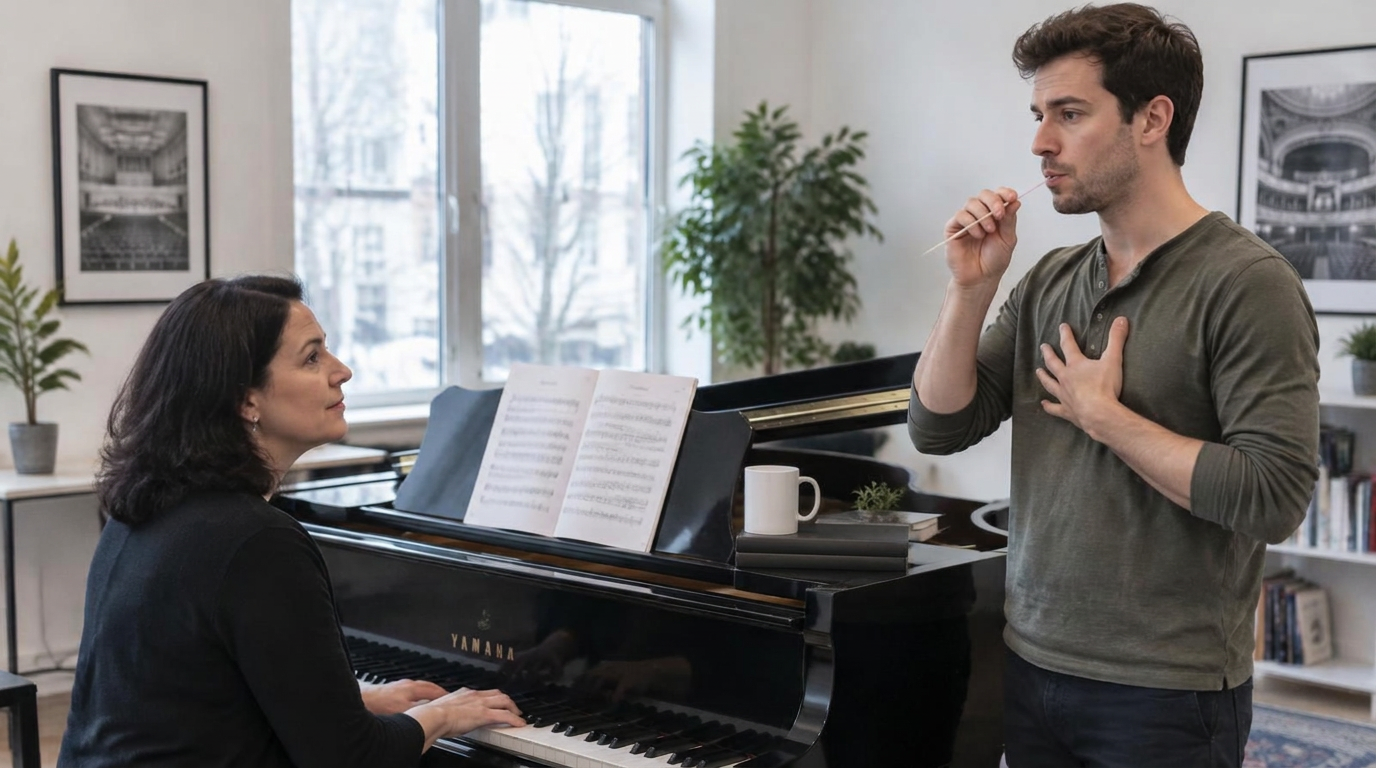
Some of the most musical singers I work with have a frustrating secret: they hear perfectly well that a note is slightly flat or sharp, yet their voice drifts anyway — usually not on the high notes everyone worries about, but in the middle of the range, on ordinary phrases that should feel easy. This is not a problem of hearing. It is a problem of coordination: the conversation between what the ear intends and what the larynx actually does has become slow, vague or overloaded.
Why the middle voice is where pitch goes wrong
Pitch is controlled mainly by two groups of muscles. The cricothyroid (CT) muscles tilt the thyroid cartilage and lengthen the vocal folds, raising pitch; the thyroarytenoid (TA) muscles shorten and thicken the folds, giving body and lowering pitch. On every note, these two systems are negotiating a balance.
In the lower voice, TA tends to dominate; in the upper voice, CT takes the lead. The middle — roughly the area around the first register transition — is where neither is clearly in charge. Small imbalances in breath pressure or tension tip the negotiation one way or the other, and the pitch sags or creeps upward. Singers often describe it as a note that 'won't sit still'.
Subglottic pressure adds another variable. Pushing more air raises pitch slightly even when the muscles stay the same, which is why so many singers drift sharp when they get excited and flat when they get tired.
The ear knows — the voice has to learn to listen
Accurate singing depends on a fast feedback loop: the auditory system compares the sound you are making with the sound you intended, and the motor system makes tiny corrections — often within a fraction of a second. In my studio I call this ear–voice coordination, and in singers with a good musical ear it is almost always trainable.
What usually breaks the loop is excess effort. When the throat, jaw or tongue is braced, the fine adjustments the ear asks for cannot get through; the voice responds in coarse steps instead of smooth ones. When diagnosing mid-range instability at the piano, I listen less for wrong notes and more for how a singer arrives at a note — whether they land on it cleanly, scoop into it, or slide around it before settling.
Semi-occluded drills: lowering the load so coordination can return
Semi-occluded vocal tract (SOVT) exercises — lip trills, straw phonation, humming, voiced [v] and [z] — partially narrow the mouth opening. This creates back-pressure that helps the vocal folds vibrate efficiently with less effort, as voice scientist Ingo Titze and others have documented. For pitch work their value is simple: when the load drops, the small muscles regain the freedom to make precise adjustments.
- Straw glides: through a narrow straw, slide slowly from the bottom to the top of a comfortable fifth and back, without breaks or bumps in the sound.
- Lip-trill sirens on a held pitch: sustain one middle-range note on a lip trill for five seconds, then move to the next semitone. The trill must stay even — if it stops, the pressure is wrong, not the pitch.
- Hum-to-vowel transfer: hum a note, open to [u], then to [o], keeping exactly the same pitch and sensation.
Precision drills for intonation
Once the voice feels lighter, we move to drills that make the brain choose the pitch deliberately rather than approximately. These work best slowly and quietly — volume hides intonation problems instead of solving them.
- Unison matching: play a single note on the piano, listen, then sing it on [u] at a soft dynamic. Hold until the 'beating' between voice and piano disappears.
- Half-step pairs: sing two adjacent semitones back and forth (for example E–F–E–F) on [ng] or [v], aiming for clean arrivals with no slide between them.
- Interval anchors: sing 1–3–5–3–1 on a neutral vowel, pausing silently before each note to hear it internally first. Audiation before phonation is the core of the drill.
- Drone practice: sing slow scales over a sustained tonic drone and notice which degrees tend to drift; those are your personal 'unstable' notes.
Common reasons the drills stop working
The most frequent problem is practising too loudly or too long. Neuromuscular coordination improves through many short, accurate repetitions — ten focused minutes a day do more than an hour of tired singing. The second is skipping recording: singers are often surprised to discover their drift happens at the end of phrases, when breath runs low, rather than at the start.
Finally, instability that appears suddenly in a voice that used to be accurate, especially with hoarseness or discomfort, is a medical question rather than a technical one, and deserves an evaluation by a laryngologist or a voice-specialised speech-language pathologist.
From drills to repertoire
The goal is not to sing exercises beautifully but to carry that precision into songs. I usually take the most unstable phrase of a student's repertoire and sing it first on a lip trill, then on a single vowel, then with consonants only, and only then with the full text. Classical singers and musical theatre performers alike find that the phrase they 'always' sang under pitch begins to settle within a few weeks. For singers who want guided practice, the online coaching format is well suited to this work — see the musical theatre coaching programme or the lessons for adult singers building their technique.
Juliana Polansky recommends: Practise pitch quietly. If you can sing a phrase in tune at half volume on a lip trill, you have the coordination; louder singing simply has to keep it. If you can only find the note by pushing, the coordination is not there yet.

About the author
Juliana Polansky
Vocal coach specialising in classical technique and musical theatre, teaching private lessons online and in person by request in Southern California.
If you are working through similar vocal concerns, preparing for an audition, or have specific goals for your voice, you are warmly welcome to reach out — we can start with a private diagnostic consultation.